Circular economy
Circular economy
Thought leadership
Stewards of place
Since the IAM was founded in 1994, asset managers have turned maintenance into life-cycle decision-making and made asset management a board-level discipline. ISO 55000 gave us a shared global standard. The results are real: better safety, longer asset lives, higher performance and lower costs.
But our built environment success has come at a price. Wildlife populations have fallen by more than two-thirds since 1970; around 75 per cent of land has been altered significantly; and six of the nine critical planetary boundaries have been crossed.
This doesn’t mean that asset management failed. It means our system boundary is too narrow. If the broader system is heading the wrong way, optimising within it just gets us there faster.
Infrastructure, so far, has been built around an extractive model: resources are taken, converted into products and financial returns, and the resulting environmental and social depletion are treated as externalities. Sustainability targets have improved this model, but our planetary overshoots tell us that reducing harm is no longer sufficient. Climate change, biodiversity loss, resource depletion, inequality and declining community resilience demonstrate the need for a deeper transition, from doing less damage to actively creating the conditions for life to thrive.
Regenerative infrastructure requires a fundamental rethink of purpose, value and success. Financial performance remains essential, but it becomes one dimension of a wider concept of value that includes healthy ecosystems, thriving communities, meaningful work and long-term resilience. The businesses most capable of prospering in the coming decades will increasingly be those that recognise this interdependence.
What is regenerative asset management?
It means moving beyond maintaining assets efficiently and reducing their negative impacts to actively improving the social and ecological systems they serve (figure 1). It treats infrastructure not as isolated physical assets, but as part of interconnected living systems of communities, landscapes, ecosystems and economies. Decisions, therefore, must consider how railways, roads, water, energy and other infrastructure can collectively restore nature, strengthen communities, build resilience and create wider long-term value. Rather than asking simply ‘how do we optimise the asset?’, regenerative asset management asks ‘how do we optimise social and ecological health for this place, and what is the role of this asset?’.
The good news is that this is already going into the mainstream. From November 2026 in the UK, biodiversity net gain applies to major infrastructure projects. Circular economy thinking, nature-based solutions and the Sustainable Development Goals all point the same way. Regenerative asset management pulls all these threads together.
“Asset management hasn’t failed... [but] our system boundary is too narrow. If the broader system is heading the wrong way, optimising within it just gets us there faster”
So, how do we do it?
There are many pathways evolving to get this done. However, to improve incrementally, and to move quickly and at scale, we propose a set of three simple principles as a common anchor.
- Future-facing: be open to and aware of what is going on. This isn’t about confronting the changes that are coming, but working with them, building resilience in infrastructure, in our natural systems and in human society.
- Think in whole living systems: work to understand the interconnected relationships between people, nature, places and economies, and then design for their collective flourishing.
- Start with place: design for each location’s specific ecosystem and community.
To assist with this, we have developed a holistic infrastructure management approach (figure 2) that widens the value boundary by taking an ecosystem awareness frame and blending data-driven decision analysis with deeper understanding of the relationships between people, infrastructure and the wider natural world. This can be applied to specific infrastructure projects and wider regional development initiatives.
Regeneration in practice
We are also in the process of building a catalogue of case studies to demonstrate regenerative asset management and to create a common understanding of best practice with the professional asset management community.

Figure 1: From conventional to regenerative asset management (Source: Developed from Arlind Dervishaj amd Regenesis/Bill Reed)
Figure 1: From conventional to regenerative asset management (Source: Developed from Arlind Dervishaj amd Regenesis/Bill Reed)

Figure 2: Holistic infrastructure management approach (Source: Adeney/MacLennan)
Figure 2: Holistic infrastructure management approach (Source: Adeney/MacLennan)
Since the IAM was founded in 1994, asset managers have turned maintenance into life-cycle decision-making and made asset management a board-level discipline. ISO 55000 gave us a shared global standard. The results are real: better safety, longer asset lives, higher performance and lower costs.
But our built environment success has come at a price. Wildlife populations have fallen by more than two-thirds since 1970; around 75 per cent of land has been altered significantly; and six of the nine critical planetary boundaries have been crossed.
This doesn’t mean that asset management failed. It means our system boundary is too narrow. If the broader system is heading the wrong way, optimising within it just gets us there faster.
Infrastructure, so far, has been built around an extractive model: resources are taken, converted into products and financial returns, and the resulting environmental and social depletion are treated as externalities. Sustainability targets have improved this model, but our planetary overshoots tell us that reducing harm is no longer sufficient. Climate change, biodiversity loss, resource depletion, inequality and declining community resilience demonstrate the need for a deeper transition, from doing less damage to actively creating the conditions for life to thrive.
Regenerative infrastructure requires a fundamental rethink of purpose, value and success. Financial performance remains essential, but it becomes one dimension of a wider concept of value that includes healthy ecosystems, thriving communities, meaningful work and long-term resilience. The businesses most capable of prospering in the coming decades will increasingly be those that recognise this interdependence.
What is regenerative asset management?
It means moving beyond maintaining assets efficiently and reducing their negative impacts to actively improving the social and ecological systems they serve (figure 1). It treats infrastructure not as isolated physical assets, but as part of interconnected living systems of communities, landscapes, ecosystems and economies. Decisions, therefore, must consider how railways, roads, water, energy and other infrastructure can collectively restore nature, strengthen communities, build resilience and create wider long-term value. Rather than asking simply ‘how do we optimise the asset?’, regenerative asset management asks ‘how do we optimise social and ecological health for this place, and what is the role of this asset?’.
Figure 1: From conventional to regenerative asset management (Source: Developed from Arlind Dervishaj amd Regenesis/Bill Reed)
The good news is that this is already going into the mainstream. From November 2026 in the UK, biodiversity net gain applies to major infrastructure projects. Circular economy thinking, nature-based solutions and the Sustainable Development Goals all point the same way. Regenerative asset management pulls all these threads together.
“Asset management hasn’t failed... [but] our system boundary is too narrow. If the broader system is heading the wrong way, optimising within it just gets us there faster”
So, how do we do it?
There are many pathways evolving to get this done. However, to improve incrementally, and to move quickly and at scale, we propose a set of three simple principles as a common anchor.
- Future-facing: be open to and aware of what is going on. This isn’t about confronting the changes that are coming, but working with them, building resilience in infrastructure, in our natural systems and in human society.
- Think in whole living systems: work to understand the interconnected relationships between people, nature, places and economies, and then design for their collective flourishing.
- Start with place: design for each location’s specific ecosystem and community.
To assist with this, we have developed a holistic infrastructure management approach (figure 2) that widens the value boundary by taking an ecosystem awareness frame and blending data-driven decision analysis with deeper understanding of the relationships between people, infrastructure and the wider natural world. This can be applied to specific infrastructure projects and wider regional development initiatives.
Figure 2: Holistic infrastructure management approach (Source: Adeney/MacLennan)
Regeneration in practice
We are also in the process of building a catalogue of case studies to demonstrate regenerative asset management and to create a common understanding of best practice with the professional asset management community.
“Rather than asking simply ‘how do we optimise the asset?’, regenerative asset management asks ‘how do we optimise social and ecological health for this place, and what is the role of this asset?’”

Figure 3: The Keyn Glas ‘Green Ribs’ scheme is a major regenerative landscape project to mitigate the environmental impact of the A30 road upgrade in Cornwall (Source: Arup, Highways England)
Figure 3: The Keyn Glas ‘Green Ribs’ scheme is a major regenerative landscape project to mitigate the environmental impact of the A30 road upgrade in Cornwall (Source: Arup, Highways England)
For example, on the A30 in the far west of England, the Keyn Glas ‘Green Ribs’ scheme reconnects 32 fragmented habitats through wildlife crossings and wetlands, improving biodiversity, water management and resilience at once (figure 3). On railways and roads, vegetation is increasingly being managed as a multifunctional asset: storing carbon, cooling air, attenuating water and protecting manufactured assets from damage.
In Singapore, nearly all construction waste is recycled. Projects identify reusable components before demolition, so ‘disposable’ assets become material banks, cutting landfill, construction traffic and conserving resources.
There is an imperative to change our approach to data centres, with their fast-growing construction pipeline. With growing competition for energy, water, land and community support, data centres need to earn and maintain their environmental and social licence to operate by creating visible local value to justify the demands they place on shared resources. The regenerative asset manager’s role is to take the opportunity to actively design the asset management system that creates the environmental and community value, so data centres improve the place and community in which they operate. This is achieved by designing, building and managing data centres as part of local living systems: powered by excess renewable energy; recovering waste heat for homes and businesses; restoring habitats and watersheds; creating circular water systems; supporting local employment; and sharing infrastructure and value with communities. A regenerative approach integrates these interventions around the unique potential of each place.
Asset managers as stewards of place
So, what’s next for our discipline? In short, we need to become stewards of place. We still manage assets, but we design around service, resilience and ecological health, moving towards hybrid systems in which natural and built assets work together. We need to: redefine value; expand the boundary; treat nature as infrastructure; co-design with place; and shift from asset optimisation to place-based stewardship. The objective isn’t efficient assets; it is reliable service within a thriving living system.
This is as much about behaviour as technique. Think differently. Build community. Act now. Be playful. Try something small, then build on it. We know we are not alone – and we hope this shared enquiry nourishes the collaboration needed to make regenerative asset management real.
Will Adeney is Director of Blue Spring Advisory and Principal at TerraLupa, working with businesses to make major infrastructure schemes regenerative in place.
Miriam MacLennan is an Associate Director in asset management at Arup, specialising in rail, infrastructure resilience and the emerging practice of regenerative asset management.
For example, on the A30 in the far west of England, the Keyn Glas ‘Green Ribs’ scheme reconnects 32 fragmented habitats through wildlife crossings and wetlands, improving biodiversity, water management and resilience at once (figure 3). On railways and roads, vegetation is increasingly being managed as a multifunctional asset: storing carbon, cooling air, attenuating water and protecting manufactured assets from damage.
Figure 3: The Keyn Glas ‘Green Ribs’ scheme is a major regenerative landscape project to mitigate the environmental impact of the A30 road upgrade in Cornwall (Source: Arup, Highways England)
In Singapore, nearly all construction waste is recycled. Projects identify reusable components before demolition, so ‘disposable’ assets become material banks, cutting landfill, construction traffic and conserving resources.
There is an imperative to change our approach to data centres, with their fast-growing construction pipeline. With growing competition for energy, water, land and community support, data centres need to earn and maintain their environmental and social licence to operate by creating visible local value to justify the demands they place on shared resources. The regenerative asset manager’s role is to take the opportunity to actively design the asset management system that creates the environmental and community value, so data centres improve the place and community in which they operate. This is achieved by designing, building and managing data centres as part of local living systems: powered by excess renewable energy; recovering waste heat for homes and businesses; restoring habitats and watersheds; creating circular water systems; supporting local employment; and sharing infrastructure and value with communities. A regenerative approach integrates these interventions around the unique potential of each place.
Asset managers as stewards of place
So, what’s next for our discipline? In short, we need to become stewards of place. We still manage assets, but we design around service, resilience and ecological health, moving towards hybrid systems in which natural and built assets work together. We need to: redefine value; expand the boundary; treat nature as infrastructure; co-design with place; and shift from asset optimisation to place-based stewardship. The objective isn’t efficient assets; it is reliable service within a thriving living system.
This is as much about behaviour as technique. Think differently. Build community. Act now. Be playful. Try something small, then build on it. We know we are not alone – and we hope this shared enquiry nourishes the collaboration needed to make regenerative asset management real.
Will Adeney is Director of Blue Spring Advisory and Principal at TerraLupa, working with businesses to make major infrastructure schemes regenerative in place.
Miriam MacLennan is an Associate Director in asset management at Arup, specialising in rail, infrastructure resilience and the emerging practice of regenerative asset management.
This article is based on ‘Beyond Sustainable’, presented at the IAM Global Conference 2026 in London. If you wish to discover more, you can contact the authors Will Adeney and Miriam MacLennan
Opinion
Carl Waring
Building readiness for the circular economy
Are we managing assets or managing outcomes?
Are we simply managing assets or are we enabling the outcomes those assets provide? The distinction matters. The circular economy challenges us to focus on value: reliability, resilience, customer experience, environmental performance and societal benefit.
This changes the conversation. Life extension, remanufacturing, interoperability, servitisation – moving from selling physical products to offering integrated services and outcome-based solutions – and sharing models become strategic choices for delivering value, rather than isolated initiatives. When organisations focus on outcomes rather than ownership, they unlock opportunities to create value beyond price, and develop more resilient and sustainable operating models.
Circular economy starts with strategy
Circular economy thinking is often delegated to sustainability or operational teams. However, the greatest opportunities are found in the boardroom.
Corporate strategy determines organisational purpose, value creation and market position. These decisions influence investment priorities, commercial frameworks and, ultimately, how assets are managed.
Organisations that incorporate circular economy thinking in strategy can compete on resilience, sustainability and resource productivity, meaning customer outcomes can create entirely new value streams.
The circular economy readiness framework
The circular economy readiness framework (CERF) acts as both a design and diagnostic tool. It integrates business strategy, circular economy principles, strategic asset management and systems thinking to help organisations assess their readiness for outcome-centric value creation. The framework adopts a multi-perspective approach, considering both investor and supply-chain viewpoints to understand how value is created, exchanged and sustained across an ecosystem.
CERF recognises the importance of market conditions: enabling conditions, behaviours and shared-value mechanisms that are both created by and drawn from stakeholders with shared long-term goals. These conditions are sustained through collaborative commercial frameworks that support value creation beyond traditional transactional relationships.
CERF is built around four interconnected pillars:
- Strategic alignment focuses on aligning circular economy activity with organisational purpose, market position and value creation. This enables organisations to evolve from creating value through asset ownership and product sales towards creating value through capability outcomes, resilience and long-term stakeholder benefits.
- Systems integration uses systems thinking to understand interdependencies across organisations, supply chains and wider ecosystems. It helps organisations move away from responding to market constraints towards shaping markets, interoperability standards and collaborative value networks.
- Asset value optimisation focuses on maximising asset utility and whole-life value, supporting the transition away from traditional maintenance and replacement strategies towards adaptable, reusable and service-orientated asset solutions.
- Stakeholder collaboration promotes teamwork across organisational boundaries to create shared value, improve resilience and enable innovation. It moves relationships beyond transactional exchanges towards long-term partnerships that benefit the wider ecosystem.
Together, these pillars help organisations understand whether they are ready to make the transition from asset-centric decision-making to outcome-centric value creation.
Where should organisations start?
Some organisations may begin their circular economy journey through business model innovation and value proposition development. Others could focus on tactical areas such as governance, procurement and investment processes. Many begin operationally through life extension, repair, reuse and remanufacturing initiatives.
Operational improvements provide visible benefits, strategic interventions create long-term direction, and tactical activities connect the two through governance and decision-making. The most effective organisations develop all three simultaneously, delivering immediate improvements while building the foundations for long-term transformation.
Perhaps the most significant opportunity offered by the circular economy is its ability to reshape markets.
Through strategic asset management, organisations can create alternative value streams using outcome-based contracts, service-based models, interoperability platforms and collaborative partnerships. In this context, organisations are not simply responding to market conditions; they are actively shaping them.
Consequently, asset management becomes a means of enabling innovation, creating competitive advantage and supporting new forms of value creation.
By incorporating a readiness assessment, CERF enables organisations and their ecosystems to understand the extent to which circular economy activity is strategically aligned, embedded and capable of delivering sustainable outcomes. This provides a practical mechanism for monitoring progress while maintaining a focus on value creation.
Research also suggests that strategic asset management can make a significant contribution to the development of circular economy practice by enabling outcomes beyond price – including resilience, sustainability, customer value and long-term societal benefit.
Those organisations that successfully make that transition will be best placed to unlock new forms of value, strengthen resilience and remain relevant in an increasingly resource-constrained world.
“When organisations focus on outcomes rather than ownership, they unlock opportunities to create value beyond price, and develop more resilient and sustainable operating models”
Carl Waring specialises in helping organisations navigate complex and often ambiguous infrastructure challenges. He is regularly engaged in developing asset management strategy, investigating governance and management issues, and applying systems thinking to improve decision-making across complex socio-technical environments. His focus is on creating alignment between organisational goals, governance arrangements, stakeholder needs and long-term infrastructure value.
Are we simply managing assets or are we enabling the outcomes those assets provide? The distinction matters. The circular economy challenges us to focus on value: reliability, resilience, customer experience, environmental performance and societal benefit.
This changes the conversation. Life extension, remanufacturing, interoperability, servitisation – moving from selling physical products to offering integrated services and outcome-based solutions – and sharing models become strategic choices for delivering value, rather than isolated initiatives. When organisations focus on outcomes rather than ownership, they unlock opportunities to create value beyond price, and develop more resilient and sustainable operating models.
Circular economy starts with strategy
Circular economy thinking is often delegated to sustainability or operational teams. However, the greatest opportunities are found in the boardroom.
Corporate strategy determines organisational purpose, value creation and market position. These decisions influence investment priorities, commercial frameworks and, ultimately, how assets are managed.
Organisations that incorporate circular economy thinking in strategy can compete on resilience, sustainability and resource productivity, meaning customer outcomes can create entirely new value streams.
The circular economy readiness framework
The circular economy readiness framework (CERF) acts as both a design and diagnostic tool. It integrates business strategy, circular economy principles, strategic asset management and systems thinking to help organisations assess their readiness for outcome-centric value creation. The framework adopts a multi-perspective approach, considering both investor and supply-chain viewpoints to understand how value is created, exchanged and sustained across an ecosystem.
“When organisations focus on outcomes rather than ownership, they unlock opportunities to create value beyond price, and develop more resilient and sustainable operating models”
CERF recognises the importance of market conditions: enabling conditions, behaviours and shared-value mechanisms that are both created by and drawn from stakeholders with shared long-term goals. These conditions are sustained through collaborative commercial frameworks that support value creation beyond traditional transactional relationships.
CERF is built around four interconnected pillars:
- Strategic alignment focuses on aligning circular economy activity with organisational purpose, market position and value creation. This enables organisations to evolve from creating value through asset ownership and product sales towards creating value through capability outcomes, resilience and long-term stakeholder benefits.
- Systems integration uses systems thinking to understand interdependencies across organisations, supply chains and wider ecosystems. It helps organisations move away from responding to market constraints towards shaping markets, interoperability standards and collaborative value networks.
- Asset value optimisation focuses on maximising asset utility and whole-life value, supporting the transition away from traditional maintenance and replacement strategies towards adaptable, reusable and service-orientated asset solutions.
- Stakeholder collaboration promotes teamwork across organisational boundaries to create shared value, improve resilience and enable innovation. It moves relationships beyond transactional exchanges towards long-term partnerships that benefit the wider ecosystem.
Together, these pillars help organisations understand whether they are ready to make the transition from asset-centric decision-making to outcome-centric value creation.
Where should organisations start?
Some organisations may begin their circular economy journey through business model innovation and value proposition development. Others could focus on tactical areas such as governance, procurement and investment processes. Many begin operationally through life extension, repair, reuse and remanufacturing initiatives.
Operational improvements provide visible benefits, strategic interventions create long-term direction, and tactical activities connect the two through governance and decision-making. The most effective organisations develop all three simultaneously, delivering immediate improvements while building the foundations for long-term transformation.
Perhaps the most significant opportunity offered by the circular economy is its ability to reshape markets.
Through strategic asset management, organisations can create alternative value streams using outcome-based contracts, service-based models, interoperability platforms and collaborative partnerships. In this context, organisations are not simply responding to market conditions; they are actively shaping them.
Consequently, asset management becomes a means of enabling innovation, creating competitive advantage and supporting new forms of value creation.
By incorporating a readiness assessment, CERF enables organisations and their ecosystems to understand the extent to which circular economy activity is strategically aligned, embedded and capable of delivering sustainable outcomes. This provides a practical mechanism for monitoring progress while maintaining a focus on value creation.
Research also suggests that strategic asset management can make a significant contribution to the development of circular economy practice by enabling outcomes beyond price – including resilience, sustainability, customer value and long-term societal benefit.
Those organisations that successfully make that transition will be best placed to unlock new forms of value, strengthen resilience and remain relevant in an increasingly resource-constrained world.
Carl Waring specialises in helping organisations navigate complex and often ambiguous infrastructure challenges. He is regularly engaged in developing asset management strategy, investigating governance and management issues, and applying systems thinking to improve decision-making across complex socio-technical environments. His focus is on creating alignment between organisational goals, governance arrangements, stakeholder needs and long-term infrastructure value.
Thought leadership
Revive and replace
The English saying ‘a stitch in time saves nine’ was never more applicable than to UK water company assets. Maintaining assets before they fail is so much easier than waiting until they do. However, until recently, the level of investment in maintaining buried infrastructure has suggested that pipes should last around 2,000 years in the UK, which is unlikely to be the case. A burst main or a failed sewer can cause thousands of pounds of damage, as well as a potential risk to public health.
The National Engineering Policy Centre, a consortium of engineering organisations led by the Royal Academy of Engineering, considered this such a major issue that it has prepared a report ‘Reviving our ageing infrastructure’.
The IAM contributed to this report, which aims to demonstrate to the UK government that expenditure on infrastructure assets is money well spent, saving between £5 and £10 for every £1 spent.
Water hydrant in Madagascar
Water tower in India
“Expenditure on infrastructure assets is money well spent, saving between £5 and £10 for every £1 spent”
Report recommendations
The report identifies seven cross-cutting enablers of change that are needed to achieve a robust and sustainable approach to infrastructure investment:
- Outcomes, regulation and standards: we require a long-term vision for reliable and resilient infrastructure that meets future societal needs, underpinned by regulations and standards.
- Financing for the long term: a long-term arrangement with the flexibility to optimally balance proactive maintenance, renewal and enhancement of infrastructure assets.
- Skills and capability: a well-supported, respected and skilled workforce, equipped to develop and deploy new and established techniques, to steward the UK’s ageing infrastructure systems.
- Accurate data and digital tools: these must be the backbone of proactive infrastructure management, turning status and trend information into actionable insight to optimise the nature and timing of maintenance and renewal interventions.
- Innovation: plans to actively encourage purpose-driven and collaborative innovation to extend the life of ageing infrastructure to minimise cost and disruption.
- Societal awareness: a new narrative needs to be fostered where maintenance, renewal and enhancement of existing infrastructure are valued, and the trade-offs between them can be debated productively.
- System coordination: enhancing coordination across infrastructure systems through clear roles, aligned governance and shared information, enabling effective stewardship of assets that span sectors, regions and authorities.
Thames Water’s Victorian mains renewal programme in the UK
Inspecting water meter readings in Abu Dhabi
Targeting investments
In the current regulatory period (AMP 8), running from April 2025 to March 2030, there has been a dramatic increase in capital investment for the water industry in England and Wales. The total amount is almost double that for the previous regulatory period (AMP 7), resulting in the largest investment programme in its history.
While some of this expenditure is needed to address, for instance, the shortfall in water resources caused by population growth, climate change and initiatives to reduce abstraction from sensitive aquifers, much of this expenditure will be needed to renew or replace ageing infrastructure, which, in some cases, dates back to Victorian times.
It is essential that this money is spent wisely, with projects focusing on where the assets are at the end of their life. Ensuring appropriately targeted investment requires more extensive asset surveys and a better understanding of rates of deterioration. New technology is facilitating these assessments, with other techniques developed to minimise disruption to the existing networks or to the roads above them. It is important that all those involved in the work understand the options available, the pitfalls to avoid and techniques that can help to keep customers in service.
Water pumps in Madagascar
“Many countries across the world are struggling
to cope with the deterioration of key assets, some of which were installed decades or even centuries ago”
Overflow tunnel from a Victorian dam in the UK
Global issue
This problem is not unique to the UK. Many countries across the world are struggling to cope with the deterioration of key assets, some of which were installed decades or even centuries ago. Many cities were established in the 19th century and some assets can date back to that time. Sadly, the maintenance of these assets is often seen as a secondary need to installing new infrastructure. The replacement of valves or meters does not attract as much attention as a new treatment plant, and water utilities across the world may struggle to obtain funding or even discover the best method of tackling the issues of ageing assets.
I am chairing an event at the International Water Association (IWA) World Water Congress that offers an excellent opportunity for people to learn and contribute ideas in a workshop titled ‘Practical approaches to managing ageing assets’. This workshop will focus on the practical aspects of projects that monitor, assess the condition of and renovate assets, including how the projects were drawn up, supplies were maintained and contracts were managed. The speakers will outline projects from across the world before the attendees have a chance to discuss, in table groups, what information and help they need, and identify successful projects.
The objective of the workshop is to exchange knowledge of technology and techniques that can be used to manage and renovate ageing assets while minimising costs and disruption to customers. The session will also look to identify attendees and other IWA members who have practical experiences that can be compiled into an IWA publication or guidance document issued via the IWA platform, under the same name as the workshop title.
It is hoped that, through collaboration and cooperation, the water industry worldwide can continue to serve its customers, even if the assets date from tens or even hundreds of years ago.
Jo Parker is a chartered civil engineer and has worked in the water industry for more than 50 years. She was made an MBE in 1994 for services to the water industry and currently works as an independent consultant.
Discover more about asset management maturity in the UK water sector
Knowledge base
Building asset intelligence at scale
Over the past decade, Transport Infrastructure Ireland (TII) has transformed its approach to asset management. What began as a programme focused on understanding the extent, condition and value of Ireland's transport assets has evolved into a comprehensive, data-driven system spanning roads, active travel infrastructure, climate resilience and, increasingly, artificial intelligence.
Today, asset management is embedded in strategic decision-making across TII, guiding how we invest in, maintain and operate some of Ireland's most valuable public assets.
TII national road network (c5,300km)
Starting with the fundamentals
By 2019, TII recognised that achieving mature asset management required a comprehensive understanding of its assets. A significant programme of inventory development and asset valuation was undertaken across the national road network, establishing a robust evidence base for future decision-making.
The exercise found that Ireland's national road network, extending more than 5,300km, has a gross replacement value of approximately €31bn, with pavements alone accounting for more than €8bn. Understanding the scale and value of these assets enabled TII to move from reactive management towards structured life-cycle planning, risk-based decision-making and long-term stewardship.
Building an asset management system
With the asset inventory and valuation established, TII developed an asset management system aligned with the principles of ISO 55000. An asset management policy, strategy and framework were introduced to create a clear line of sight between organisational objectives and operational delivery.
TII asset management structure
This framework established governance arrangements, performance objectives and decision-making processes while ensuring alignment with wider transport, sustainability and climate policies. Strategic asset management plans (SAMPs) were subsequently developed to translate these objectives into practical programmes, performance measures and improvement actions.
Performance is measured across safety, reliability, condition, resilience, sustainability, environment, customer and maximising value, with climate adaptation embedded throughout. TII’s Asset Management Framework has been underpinned by ISO 55001 principles from the outset, positioning the organisation for certification as a natural future step in its asset management journey.
Central to TII’s approach is risk-based decision-making, where investment priorities are informed by asset condition, performance, network criticality, safety impacts and climate-related risks.
TII asset management objectives
A decade of data-driven decision-making
While artificial intelligence is attracting significant attention today, TII's data-driven asset management journey began long before AI emerged.
Since 2012, TII has used the Deighton Total Infrastructure Management System (dTIMS) as the foundation of its pavement asset management programme. The system enabled a shift away from traditional ‘worst-first’ maintenance approaches, and towards evidence-based decision-making supported by life-cycle cost analysis, deterioration modelling and long-term investment planning.
More recently, TII enhanced this approach through the development of a Pavement Environmental Management System (PEMS), integrating carbon assessment, climate resilience and sustainability considerations into life-cycle planning. Investment decisions can now consider not only cost and condition outcomes but also global warming potential (GWP), reflecting the increasing importance of sustainable infrastructure delivery.
TII pavement life-cycle assessment
From data collection to asset intelligence
The next stage of TII’s evolution is focused on transforming data into actionable intelligence.
Traditional machine-based condition surveys continue to provide high-quality engineering data across approximately 5,300km of network annually. However, advances in artificial intelligence, computer vision and automated data collection are significantly expanding monitoring capability.
Vaisala RoadAI data collection
TII has deployed technologies including Vaisala RoadAI, geo-referenced video surveys, mobile GIS applications, LiDAR systems and connected vehicle data. These tools enable infrastructure data to be collected rapidly using smartphones, cameras and cloud-based analytics platforms.
Rather than replacing engineering expertise, these technologies enhance it. Automated detection of cracking, potholes, fretting, subsidence and other defects enables wider coverage, greater consistency and more frequent updates, all while maintaining engineering oversight. The result is a gradual shift from periodic inspection cycles towards continuous, intelligence-led asset management.
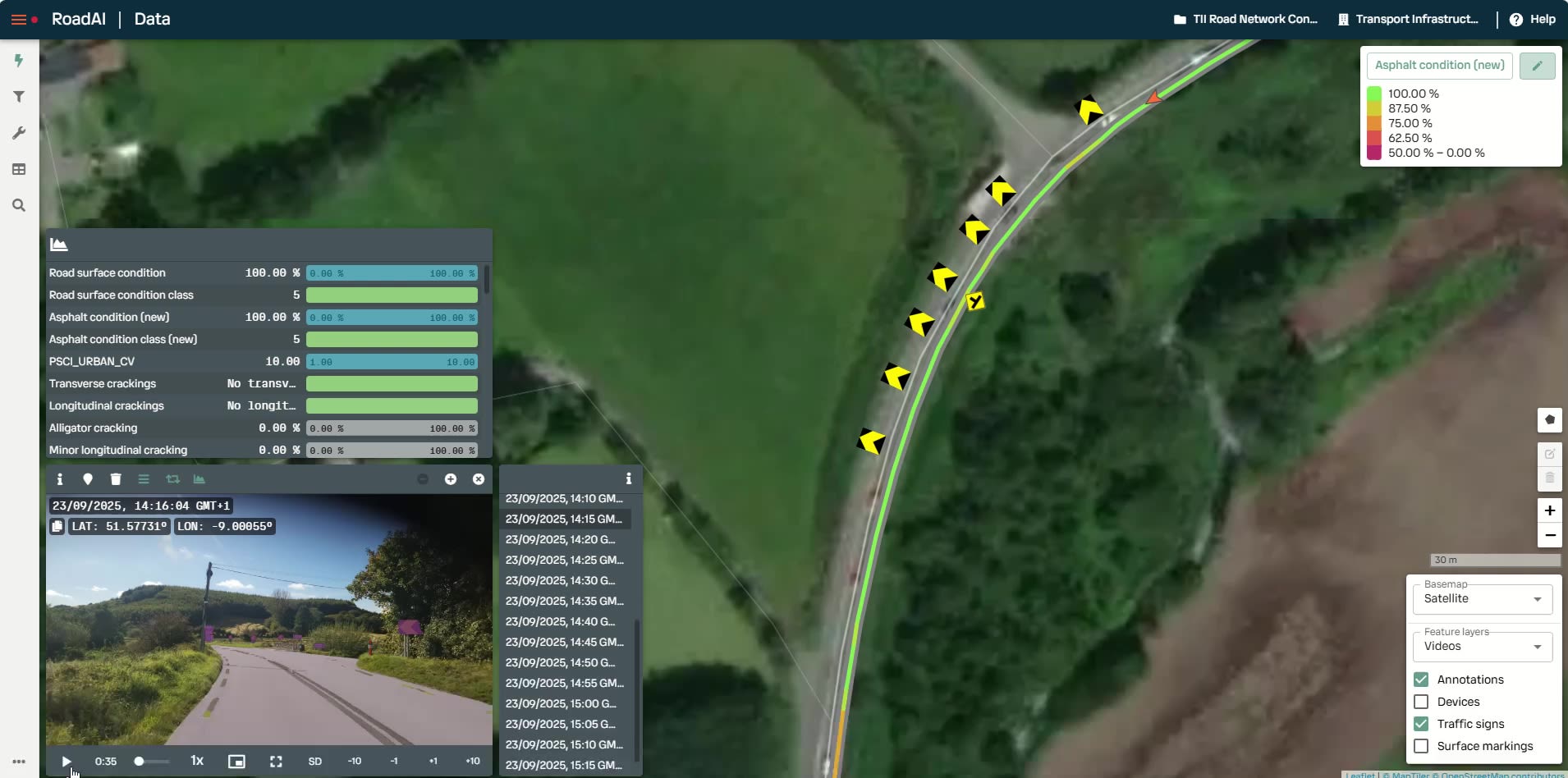
Vaisala RoadAI national road data gathering
Supporting Ireland's active travel ambitions
The rapid expansion of Ireland's active travel network has created new asset management challenges and opportunities.
TII currently manages approximately 800km of active travel infrastructure, with significant further expansion planned. To support efficient management from the outset, TII has adopted innovative approaches including smartphone-based video surveys, AI-assisted inspections and specialised LiDAR systems.
By embedding asset management principles from the earliest stages of network development, TII aims to avoid the legacy issues experienced on older infrastructure networks and ensure a proactive approach to maintenance from day one.
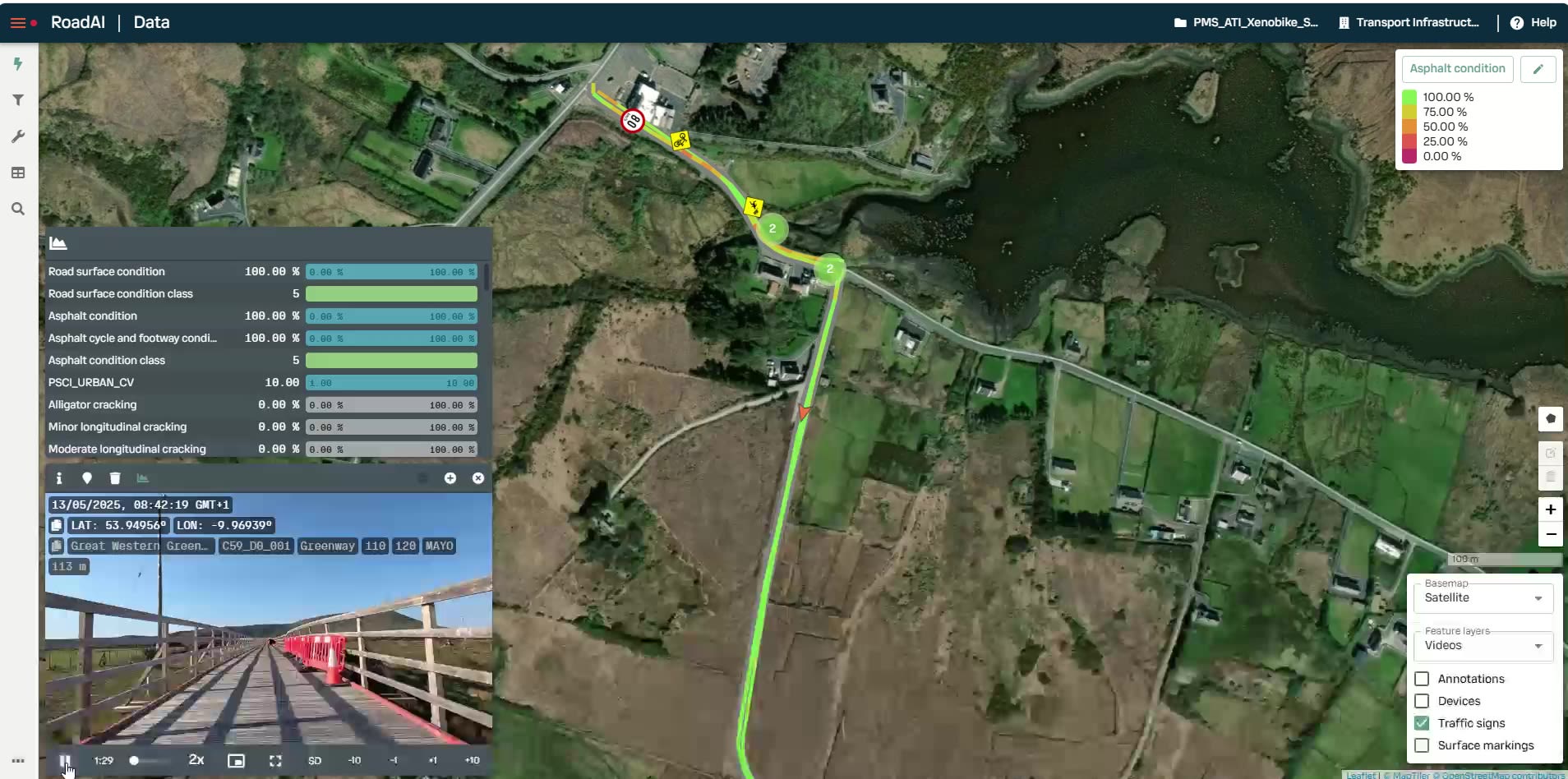
Vaisala RoadAI Greenway network data gathering
Integrating climate adaptation
Climate resilience is now recognised as a fundamental asset management requirement.
TII's Climate Adaptation Strategy and Climate Adaptation Implementation Plan are fully integrated within the broader asset management framework. Rather than treating climate adaptation as a separate initiative, resilience considerations are incorporated directly into asset planning, investment prioritisation and life-cycle management processes.
The programme spans pavements, drainage systems, bridges, structures, geotechnical assets, tunnels and motorway operations. Activities include climate risk assessments, flood vulnerability mapping, resilience programmes and adaptation planning to help ensure infrastructure remains fit for purpose under future climate conditions.
M11 flooding 2023
Looking ahead
The future of asset management at TII is increasingly centred on predictive and intelligence-led decision-making.
AI-enabled condition assessment, connected vehicle data, digital asset inventories, life-cycle modelling and climate resilience programmes are being brought together within a single decision-support framework. The goal is to create a transport asset management system that continuously gathers information, converts data into intelligence and supports proactive intervention before failures occur.
The foundations established through asset inventories, valuation, life-cycle management, climate adaptation and digital innovation are now enabling the next generation of asset management.
As TII continues this journey, and progresses towards ISO 55001 certification, the focus remains unchanged: making better decisions through better information and ensuring that Ireland's transport assets continue to deliver value for future generations.
You may also be interested in:
- TII Asset Management Portal
- TII Pavement Asset Management Guide
- TII Climate Adaptation Strategy
- TII Climate Adaptation Implementation Plan 2026 - 2030
Gerard O’Dea is a Chartered Civil Engineer with more than 15 years’ experience across areas of engineering design and consultancy, major road planning, strategic asset management, pavement condition assessment, GIS and data analytics. He joined TII in 2022 as a Senior Engineer in Asset Management and is currently Group Lead for Strategic Asset Management of Roads and Active Travel.
Stephen Smyth is a Fellow of Engineers Ireland and holds a civil engineering degree and a Master’s in operations management. With more than 30 years’ experience, he has worked across road construction, maintenance, operations, asset management and winter resilience. Since 2016, he has served as Senior Manager in TII’s Network Management Directorate, overseeing national road and greenway asset management, climate adaptation, resilience and winter services.
You can hear more about TII’s asset management programmes on this webinar
 Built with Shorthand